Pre-departure checklist for a medical trip to Korea
By KMedTrip editorial · Updated · Written with AI assistance · Reviewed by KMedTrip native-speaker review team
This guide is general information, not medical advice. KMedTrip is run by a government-registered foreign patient facilitator (an agency that helps international patients arrange medical care). We do not recommend, rank or receive payment from any hospital or clinic.
A trip for medical treatment usually requires more planning than a holiday. You need:
the usual travel documents,
health records,
a plan for recovery,
a budget for surprises.
Use this checklist in the weeks before you fly. Rules on entry and medicines can change. Check the official pages close to your departure date.
Key takeaways
Check your entry requirements early: visa, K-ETA and the e-Arrival Card.
Bring your medical history, medication list and test results, ideally in English.
Bring prescription medicines in their original packaging with a prescription or doctor’s letter. Some medicines need approval before entry.
Plan for payments (card plus some cash) and keep an emergency budget.
Pack for recovery, not sightseeing: loose clothes, comfortable shoes, sun protection.
Do not book a non-changeable flight home until your doctor confirms when you can fly.
A simple timeline
When
What to do
As early as possible
Check passport validity and your visa or K-ETA needs. Ask the clinic which records and tests it needs.
Several weeks before
Check whether any of your medicines need an MFDS permit (apply at least 10 working days before entry). Collect your medical records.
A few days before
Apply for K-ETA if you need it, if not done yet. Allow time for approval.
Within 3 days before arrival
Submit the e-Arrival Card if you need one.
The week before
Do the final check at the end of this guide.
Documents
Figure 1. Documents to prepare. ① Passport (valid for 6+ months) and a copy. ② Visa or K-ETA. ③ e-Arrival Card (within 3 days before arrival). ④ Flight booking and your address in Korean. ⑤ Appointment confirmations. ⑥ Insurance documents. ⑦ Emergency contacts.
① Passport
Check that it is valid for your whole stay plus a margin. Many airlines and countries expect at least six months of validity.
Take a photo or scan your passport. Keep it separate from the original.
② Visa or K-ETA
Your requirement depends on your nationality and how long you will stay.
K-ETA (Korea Electronic Travel Authorization) is an online travel permit for visitors who can enter without a visa.
Where: only on the official site, k-eta.go.kr. Some unofficial websites charge extra fees. Do not use them.
When: you must have approval before you board your flight. Allow at least a few days.
How much: KRW 10,000, plus an online payment fee. It is not refunded if you are refused (k-eta.go.kr, as of Oct 2026).
How to pay: a Visa, Mastercard, JCB or American Express card that can make overseas online payments (Korean Embassy in Norway, accessed Oct 2026).
Who does not need it: people aged 17 or younger, or 65 or older, on the date of entry (k-eta.go.kr, as of Oct 2026).
How long it lasts: 3 years, or until your passport expires if that is sooner (k-eta.go.kr, as of Oct 2026).
K-ETA exemption. Visitors from some countries and territories are temporarily exempt from K-ETA. Korea’s Ministry of Foreign Affairs says this has been extended to 31 December 2026 (MOFA, accessed Oct 2026). Rules for 2027 had not been announced as of October 2026. Check whether your country is on the list.
Visa needed. Some nationalities cannot enter visa-free and need a visa for any visit. Check the Korean embassy website for your country.
Medical visa. The medical tourism visa (C-3-3) is for treatment stays of 90 days or less (Medical Korea, accessed Oct 2026). Visa-free entry purposes for many countries are listed as tourism, business and similar. Treatment is not always named, but that alone does not mean it is banned. Medical Korea lists visa-free entry as one way to come for treatment (checked Oct 2026). Whether it fits your own treatment and stay is not confirmed, so ask the Korean embassy before you travel, especially for a long treatment stay or a hospital stay. See our guides on the C-3-3 visa and K-ETA.
③ e-Arrival Card
Korea now uses an online arrival card.
Where: the official site, e-arrivalcard.go.kr.
When: from 3 days before you arrive (Korean time).
How much: free (e-Arrival Card guide, as of Oct 2026).
Who: foreigners with a valid K-ETA do not need to submit it (Korea.kr, accessed Oct 2026). If you enter with a visa, or are exempt from K-ETA, you will usually need it. Check the official guide.
Paper cards: Korea said paper arrival cards could still be used alongside the e-Arrival Card until December 2025 (Korean Consulate General in Los Angeles). Plan to use the online card.
K-ETA and e-Arrival rules change often. Check the official sites again close to your departure date.
④–⑦ Other documents to carry (paper and digital)
④ Flight booking and accommodation address, also in Korean, to show taxi drivers.
⑤ Appointment confirmations from the clinic or coordinator.
⑥ Insurance documents and the insurer’s emergency phone number. Remember: travel insurance usually does not cover elective procedures (planned, non-emergency treatment you choose) or their complications. See why travel insurance does not cover procedures.
⑦ Emergency contacts at home, and your coordinator’s contact details.
Medical records to bring
Figure 2. Medical records and medicines to bring. ① Medical history summary. ② Current medication list. ③ Allergies. ④ Recent test results. ⑤ Contact details for your doctor at home. ⑥ Medicines in their original packaging with a prescription.
Good records help the Korean medical team plan safely. They also help your doctor in your home country later. The NHS and CDC both stress sharing your medical information and keeping copies (accessed Oct 2026).
Prepare these, ideally in English:
Item
What to include
① Medical history summary
Conditions, past surgery, any problems with anesthesia (medicine that numbs you or puts you to sleep)
② Current medication list
Names (generic names help), doses and how often you take them. Include supplements.
③ Allergies
Medicines, latex, foods
④ Recent test results
What your clinic asks for, such as blood tests, ECG (heart test) or dental X-rays and scans
⑤ Contact details for your doctor in your home country
So they can be reached if needed
Step by step:
Ask the clinic which records and tests it needs.
Ask your doctor at home for copies. Ask for English if possible.
Send what the clinic asks for before the trip.
Carry paper copies and keep digital copies on your phone.
⑥ Bringing medicines into Korea
Keep medicines in their original packaging with the pharmacy label.
Carry a copy of your prescription or a doctor’s letter in English.
Bring only an amount for personal use.
Some medicines are controlled in Korea. This means they contain narcotic or psychotropic substances (drugs strictly limited by law). Examples are certain strong painkillers, sleeping pills, anxiety medicines and ADHD medicines. Codeine counts as a narcotic and phenobarbital as a psychotropic in Korea (Korea Customs Service; MFDS, accessed Oct 2026).
You need a permit before you travel for controlled medicines. It comes from Korea’s Ministry of Food and Drug Safety (MFDS). This applies to every nationality.
How to get the permit, step by step (Korean Consulate General in Osaka, January 2025):
Apply online on the MFDS site, nedrug.mfds.go.kr. Online applications started on 27 December 2024.
Apply early. Processing takes 10 working days. Apply at least 10 working days before you enter Korea.
Prepare documents: a copy of your passport, your flight ticket, a doctor’s note, the prescription, and any export permit your home country requires. Add an English or Korean translation.
Bring only what is allowed: up to a 90-day supply, plus up to 5 extra days in case of flight delays.
Carry them in your hand luggage, not in checked bags. Customs checks the MFDS approval on arrival.
If you are not sure whether a medicine is controlled, ask MFDS or the Korean embassy in your country well before departure.
Plan for after the trip, too
Before you leave Korea, ask for copies of your records:
what was done,
medicines given,
any implants or materials used,
aftercare instructions.
Book a checkup with your doctor or dentist at home for after you return.
Money and payments
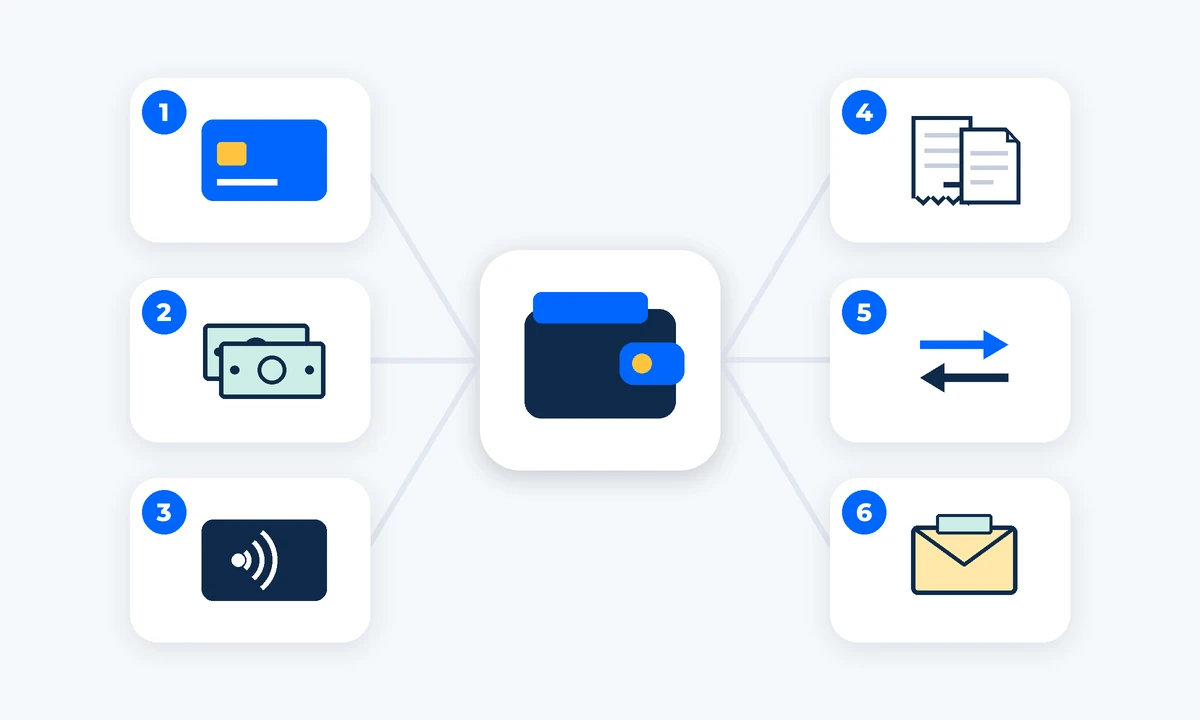
Figure 3. Money to plan for. ① Cards (tell your bank). ② Some Korean won in cash. ③ A transport card (T-money). ④ The clinic’s payment plan and receipt. ⑤ Exchange rate changes. ⑥ An emergency budget.
① Cards: credit and debit cards are widely accepted in Korea. Tell your bank your travel dates so payments are not blocked.
② Cash: carry some Korean won for small purchases and as a backup. If you bring more than USD 10,000 in total (all currencies, Korean won and cheques together), you must declare it to Korean customs on arrival. Not declaring it can lead to a fine or prison (Korea Customs Service, accessed Oct 2026). Your home country may also have its own rules for taking cash out. Check them before you go.
③ Transport card: a rechargeable card such as T-money is useful for the subway and buses.
④ Clinic payments: ask the clinic in advance how and when you will pay (deposit, card or bank transfer). Get a written quote and a receipt.
⑤ Exchange rates: the cost in your home currency may change as exchange rates move. The NHS checklist suggests factoring this in (accessed Oct 2026).
⑥ Emergency budget: keep money aside for extra nights, a changed flight or extra clinic visits. Insurance is unlikely to pay for these if an elective procedure causes them.
VAT refund on cosmetic procedures: ended. Korea used to refund VAT (value-added tax) to foreign visitors on some cosmetic procedures. That scheme ended on 31 December 2025 (Korea.kr, 2025 tax reform). As of October 2026, bills to bring it back have not been passed. Do not count on a refund in your budget. Check the news before you travel, and see our VAT refund guide.
Packing for recovery
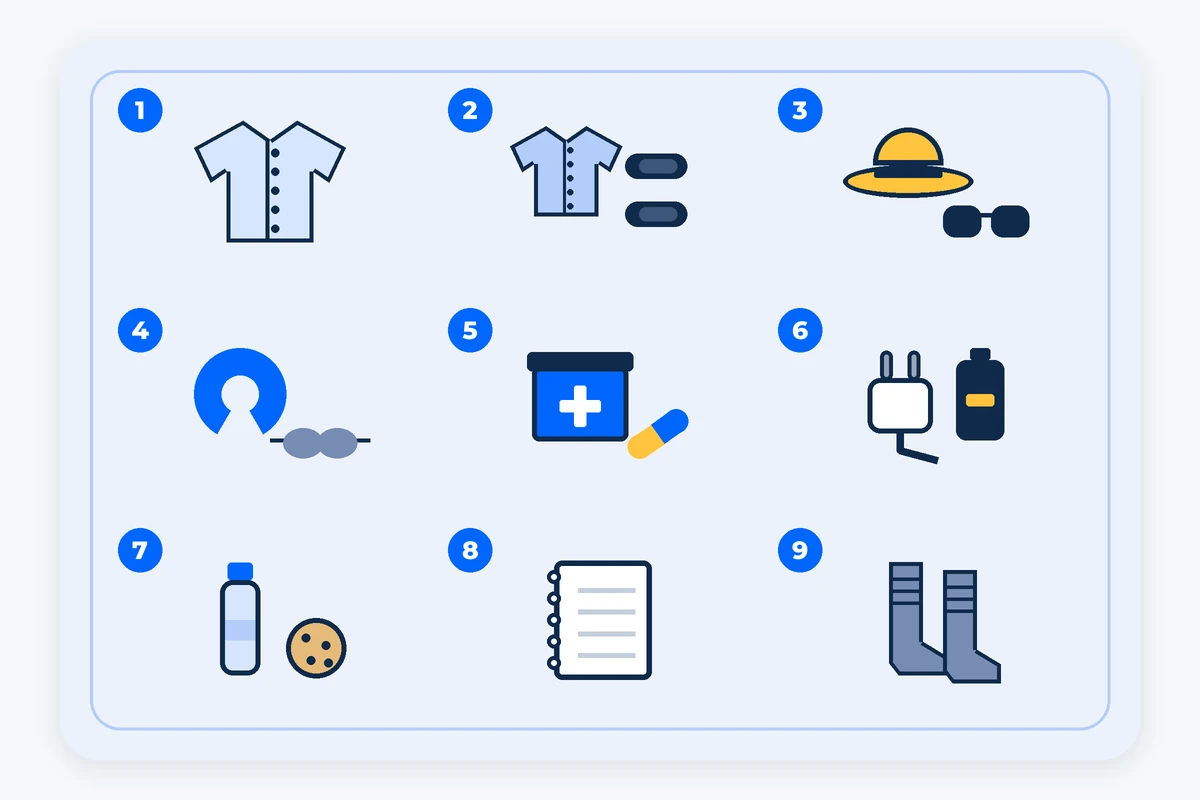
Figure 4. What to pack for recovery. ① Loose, front-opening clothes. ② Flat shoes and a light jacket. ③ Sun protection. ④ Neck pillow and eye mask. ⑤ Usual medicines plus extra days. ⑥ Charger and plug adapter (220 V, two round pins). ⑦ Snacks and a water bottle. ⑧ Notebook for questions. ⑨ Compression stockings, only if advised.
Think about how you will feel after the procedure, not before it:
Loose, front-opening clothes. They are easy to put on without lifting your arms or pulling anything over your face.
Comfortable flat shoes and a light jacket.
Sun protection: a hat, sunglasses, and any sunscreen your doctor approves. Many skin and facial treatments need strict sun protection.
A neck pillow and eye mask for the flight, and for sleeping upright if advised.
Your usual medicines, enough for the whole trip plus a few extra days.
Phone charger and a plug adapter. Korea uses 220 volts at 60 Hz, and sockets have two round holes (VISITKOREA, accessed Oct 2026).
Simple snacks and a water bottle. Soft foods may help after dental or facial treatment. Follow your clinic’s advice.
A small notebook or phone note for questions, medicine times and aftercare steps.
Compression stockings (tight socks that help blood flow), only if your doctor recommends them for the flight.
Leave room in your luggage. Plan to avoid lifting heavy bags after surgery. When you go back to the airport, choose transport that limits walking.
Final check: the week before you fly
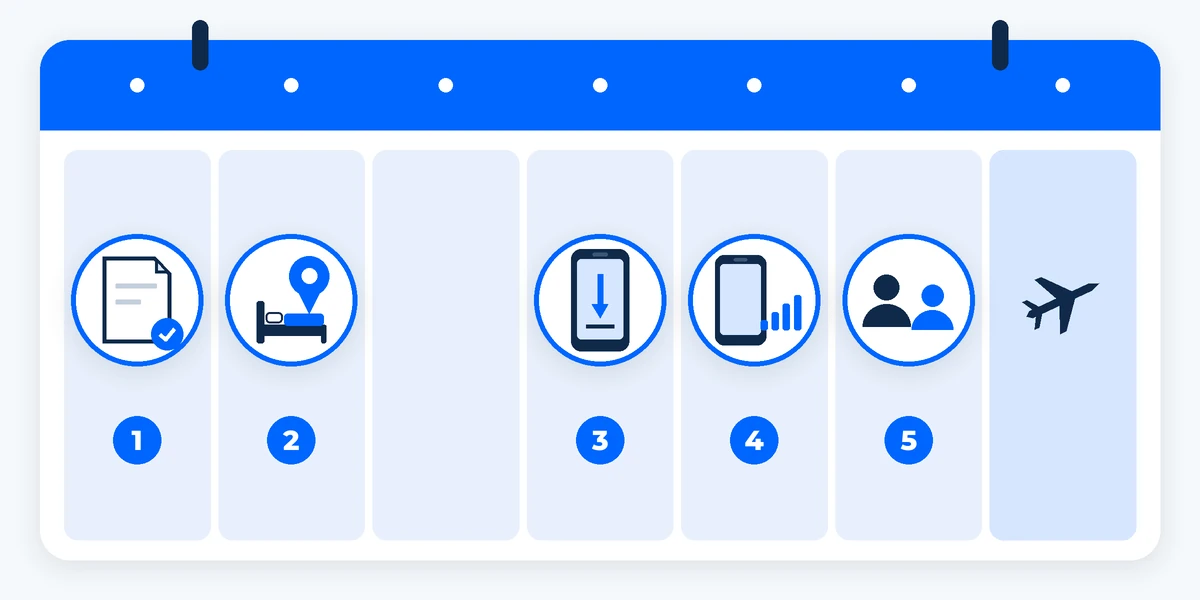
Figure 5. Five final checks in the week before you fly. ① Confirm appointments in writing. ② Confirm accommodation near the clinic. ③ Save addresses and 119 offline. ④ Set up and test phone data. ⑤ Arrange someone to help you.
Confirm appointment dates and times in writing (email or message).
Confirm your accommodation is close to the clinic and suitable for rest.
Save offline: your accommodation address in Korean, the clinic address, your coordinator’s number and Korea’s emergency number 119.
Set up your phone data (eSIM or SIM) and test it. See our eSIM comparison.
Arrange someone to help you during recovery, in Korea or at home. UK travel health guidance stresses planning who will care for you on the journey and after you return (TravelHealthPro, accessed Oct 2026).
Frequently asked questions
Do I need a K-ETA?
It depends on your nationality and age. Some nationalities are exempt until 31 December 2026 (MOFA, as of Oct 2026). People aged 17 or younger or 65 or older on the date of entry are also exempt (k-eta.go.kr). Check the official site, k-eta.go.kr. Use only the official site.
How much is the K-ETA and how long is it valid?
KRW 10,000 plus an online payment fee. It is valid for 3 years, or until your passport expires if sooner (k-eta.go.kr, as of Oct 2026).
When do I fill in the e-Arrival Card?
From 3 days before you arrive. It is free (e-Arrival Card guide, as of Oct 2026). People with a valid K-ETA do not need it (Korea.kr).
Can I bring my usual medicines?
Usually yes, for personal use, in original packaging with a prescription or doctor’s letter. Controlled medicines need an MFDS permit before you travel. Apply online at least 10 working days before you enter Korea (Korean Consulate General in Osaka, January 2025).
Can I still get a VAT refund on cosmetic procedures?
No. The scheme ended on 31 December 2025, and as of October 2026 it has not been restored. Check the news before you travel.
Which plug adapter do I need?
Korea uses 220 V and sockets with two round holes (VISITKOREA, accessed Oct 2026).