By KMedTrip editorial · Updated · Written with AI assistance · Reviewed by KMedTrip native-speaker review team
This guide is general information, not medical advice. KMedTrip is run by a government-registered foreign patient facilitator (an agency that helps international patients arrange medical care). We do not recommend, rank or receive payment from any hospital or clinic.
Many visitors combine a trip to Korea with a health checkup (건강검진, geongang geomjin). A checkup is a set of tests done when you feel well, to find problems early. Some checkups take a few hours. Others take most of a day and include scans and camera tests.
This guide explains:
the main types of checkup,
what is usually included,
what makes the price go up or down,
and how to prepare, step by step.
Key takeaways
Korea’s public screening program sets a useful “baseline” list of tests, but it is for people enrolled in Korean National Health Insurance. Short-term visitors normally pay privately.
Private checkups are sold as packages. The price depends mostly on imaging (CT, MRI, ultrasound), endoscopy and sedation.
There is no official national price for private checkup packages. Ask for an itemized quote in writing before you book.
Most checkups need fasting and some need bowel preparation, so plan your arrival day and meals around it.
Basic vs comprehensive checkups
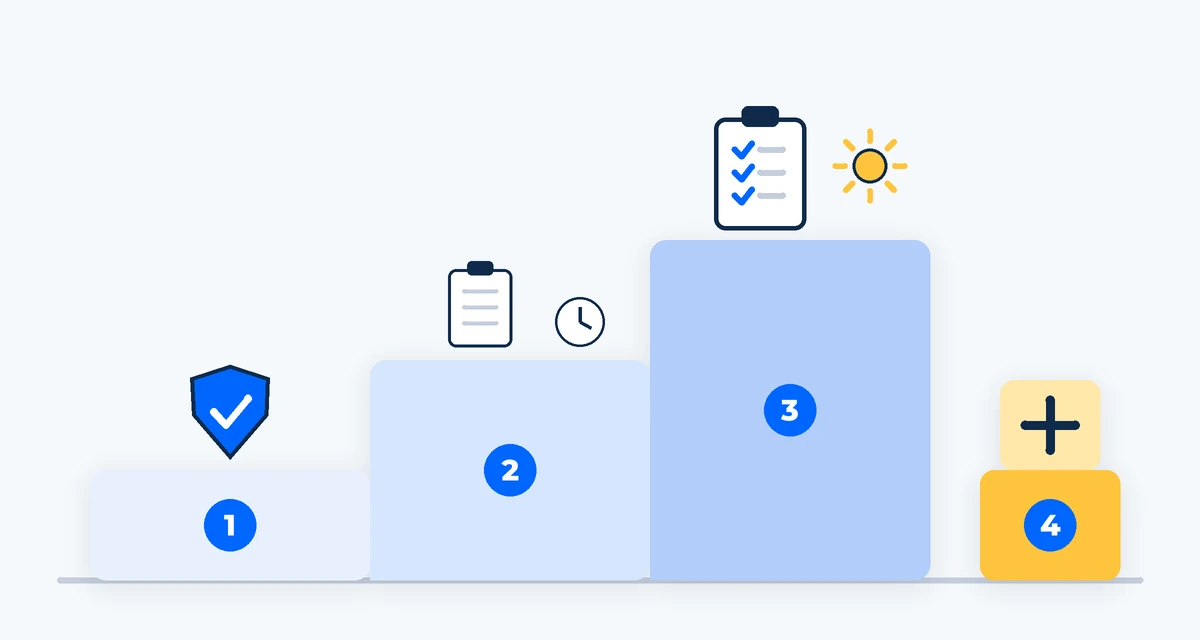
Figure 1. Three levels of checkup in Korea. ① Public (national) screening, for people enrolled in Korean National Health Insurance. ② Basic private checkup, usually a few hours. ③ Comprehensive private checkup, often most of a day. ④ Add-on tests you can add to a package.
There are three main levels. The table gives a quick view. Details follow below.
Type
Who can use it
Usual length
Who pays
Public (national) screening
People enrolled in Korean National Health Insurance
Varies
Mostly NHIS (see below)
Basic private checkup
Anyone, including visitors
Often a few hours
You
Comprehensive private checkup
Anyone, including visitors
Often most of a day
You
These lengths are general descriptions, not official figures. Ask each center for its own schedule.
Public (national) screening
Korea’s National Health Insurance Service (NHIS, the public health insurer) runs two programs for insured people:
a general health screening, and
a cancer screening program.
Costs, according to NHIS (English site, accessed October 2026):
The general screening is fully covered by NHIS.
For most cancer screenings, NHIS pays 90% and you pay 10%.
Colorectal (bowel) and cervical cancer screening are fully covered.
Foreign residents who are enrolled in NHIS can be eligible. Tourists on a short trip usually are not. See NHIS “Guidance for foreigners” for the rules.
Basic private checkup
This is a short package, often a few hours. It is usually built around:
blood and urine tests,
body measurements and blood pressure,
a chest X-ray,
a talk with a doctor.
It is similar in scope to the national general screening.
Comprehensive private checkup
This is a longer package, often most of a day. It adds imaging (scans that take pictures of the inside of the body) and procedures. Typical additions are:
Abdominal ultrasound (a scan of the belly using sound waves).
Gastroscopy (upper endoscopy: a thin camera tube passed through the mouth to look at the stomach).
Colonoscopy (a camera tube that looks inside the large bowel).
Low-dose chest CT (a lung scan using a lower amount of X-rays).
Heart tests and more detailed blood panels.
Some packages are sold by theme, such as “heart” or “women’s health”.
Add-on tests
Many centers let you add single items to a package. One example is an MRI (magnetic resonance imaging, a scan using magnets) of a specific body area. Each add-on raises the price. Some add-ons also need extra preparation.
Typical items included
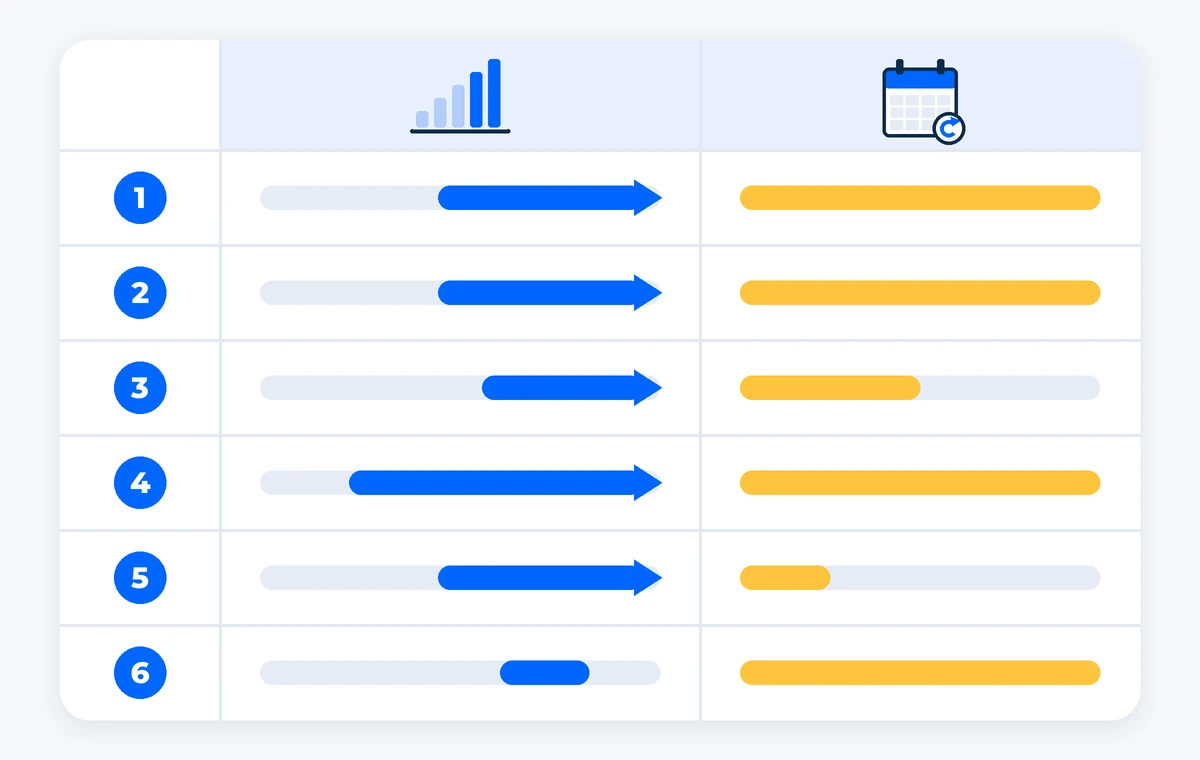
Figure 2. National cancer screening in Korea: who it is for and how often. ① Stomach: age 40+, every 2 years. ② Breast: women 40+, every 2 years. ③ Colorectal: age 50+, every year. ④ Cervical: women 20+, every 2 years. ⑤ Liver: age 40+ at high risk, every 6 months. ⑥ Lung: heavy smokers aged 54–74, every 2 years.
The national program shows what a “standard” set of tests looks like. Private packages usually start from this list.
General screening (national program, adults 20+)
According to NHIS (accessed October 2026), this usually covers:
Questionnaire and consultation
Height, weight, waist and body mass index (BMI, a number based on height and weight)
Blood pressure
Vision and hearing
Chest X-ray
Blood tests (such as blood count, fasting glucose, liver enzymes, kidney function, and cholesterol at set ages)
Urine test
Oral (dental) check
Cancer screening (national program)
NHIS sets age rules for each cancer (NHIS English site; lung row: National Cancer Center Korea; accessed October 2026):
Cancer
Who (per NHIS)
How often
Stomach
Age 40+
Every 2 years
Breast
Women 40+
Every 2 years
Colorectal
Age 50+
Every year
Cervical
Women 20+
Every 2 years
Liver
Age 40+ at high risk
Every 6 months
Lung
Heavy smokers aged 54–74
Every 2 years
“Heavy smokers” here means people aged 54–74 with a smoking history of 30 “pack-years” or more. A pack-year is packs per day multiplied by years of smoking. For example, one pack a day for 30 years is 30 pack-years. The test is a low-dose chest CT every 2 years (National Cancer Center Korea, accessed October 2026).
What private packages add
Private comprehensive packages generally include the items above. Then they add more imaging and endoscopy. Always check exactly which tests are in a package. Two packages with the same name can be very different.
Price ranges and what changes them
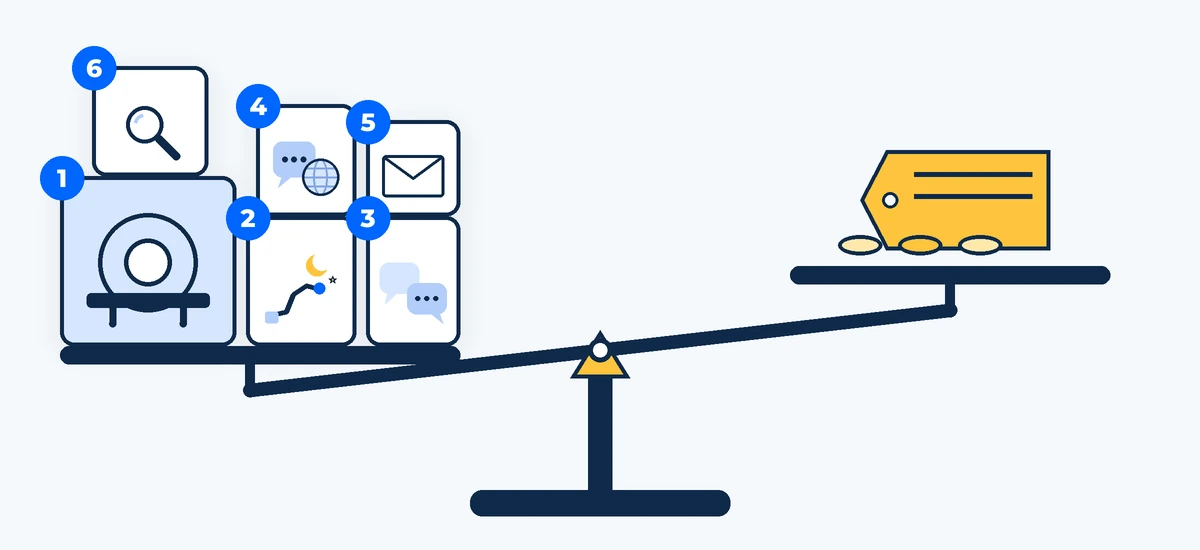
Figure 3. The main things that change a checkup price. ① Imaging (CT, MRI). ② Endoscopy and sedation. ③ Specialist consultations. ④ Language support. ⑤ Report delivery. ⑥ Follow-up tests.
What public data exists
The Korean government publishes prices for many non-covered items. “Non-covered” means not paid by Korean national insurance, so the patient pays the full price. These prices are published by HIRA (Health Insurance Review and Assessment Service, the agency that reviews medical fees).
The HIRA list shows single items at each medical institution. Ultrasound and MRI items are part of the disclosure (Ministry of Health and Welfare).
In 2026, prices for 753 non-covered items were published for about 74,000 medical institutions (Ministry of Health and Welfare, 3 September 2026).
HIRA does not publish one national price for private checkup packages. The official data gives no overall KRW range for checkups, so we do not give one.
The Ministry of Health and Welfare publishes this data every year (most recently on 3 September 2026). It shows that prices for the same non-covered item can differ a lot between institutions. So we do not give a single number here.
The six main price factors
Imaging. CT and MRI cost far more than ultrasound or X-ray. MRI is usually the largest single cost.
Endoscopy and sedation. Gastroscopy and colonoscopy are common add-ons. Sedation (medicine that makes you sleepy during the test) usually costs extra. It also means you need more rest afterwards.
Specialist consultations. A results talk with a doctor affects the cost. It matters whether it is in person on the day or later.
Language support. Interpretation and translated reports may be included or charged separately.
Report delivery. Some reports take days or weeks. An English summary may take longer or cost extra.
Follow-up. If something needs further tests, those are usually outside the package price.
How to get a quote, step by step
Choose the tests you want. Make a short list. Ask your doctor at home if you are unsure.
Ask for a written quote by email. It should list every test, the currency, and whether tax is included.
Ask what happens if extra tests are recommended. Ask how they are priced and when you must decide.
Ask about the report. Ask when it will be ready, in which language, and if there is a charge.
Preparing for the day
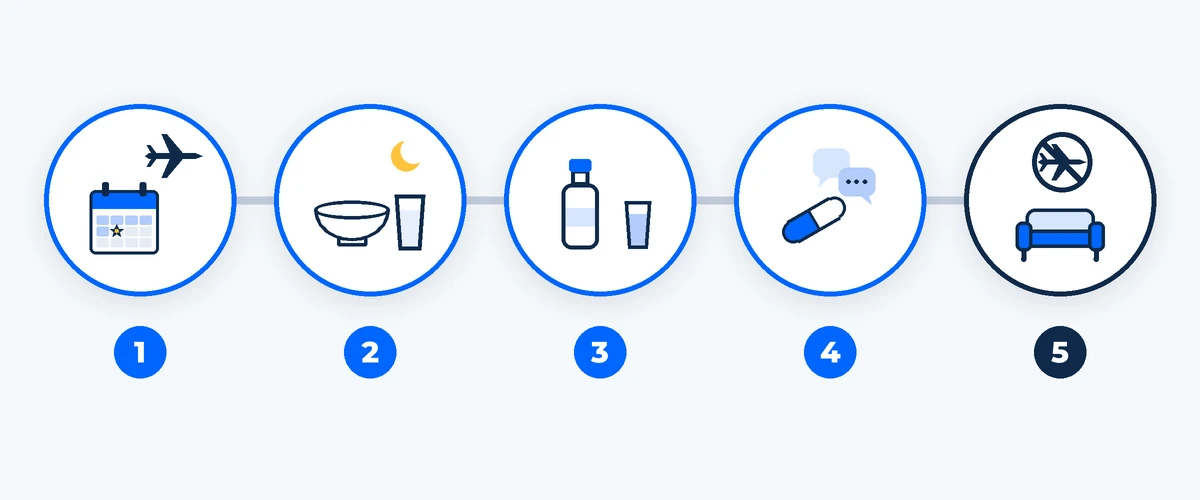
Figure 4. Preparing for a checkup. ① Arrive at least one full day before. ② Fast from the evening before (water only). ③ Do bowel preparation if you are having a colonoscopy. ④ Tell the center about your medicines. ⑤ Rest after sedation, and do not fly the same day.
Follow the exact instructions your center gives you. The steps below are general.
Step 1: Book your flight with a buffer
Arrive at least one full day before the checkup. This helps you recover from travel and jet lag.
Book the checkup early in your stay. If you need a follow-up test, you will have time.
Do not plan to fly on the same day as sedation.
Step 2: Tell the center about your medicines (before you travel)
Tell the center in advance about all medicines you take. This is especially important for:
blood thinners (medicines that stop blood from clotting),
diabetes medicines,
blood pressure medicines.
Do not stop any medicine without medical advice.
Step 3: Bowel preparation, if you have a colonoscopy
Bowel preparation means emptying the bowel so the camera can see clearly. It usually means:
a light, low-fiber diet for a few days before, and
drinking a laxative solution (a drink that makes you go to the toilet) the evening before and/or early in the morning.
As an example, the UK NHS describes eating plain, low-fiber food for about 2 days before, and taking the laxative in several doses the day before (NHS, accessed October 2026). Your center’s own instructions come first.
Stay near a toilet that evening. A long flight the day before is not ideal.
Step 4: Fast from the evening before
Most checkups need you to fast (not eat) from the evening before. Usually only water is allowed until the tests. For example, the NHS says not to eat for at least 6 hours before a gastroscopy, and small sips of water may be allowed (NHS, accessed October 2026). Follow your center’s exact times.
Can a tourist use Korea’s national health screening?
Usually not. The national program is for people enrolled in Korean National Health Insurance (NHIS, accessed October 2026). Short-term visitors normally book a private checkup and pay themselves.
How long does a checkup take?
A basic private checkup often takes a few hours. A comprehensive one often takes most of a day. Ask the center for its own schedule.
How much does a checkup cost?
There is no single national price for private packages. Prices for the same item differ between institutions (Ministry of Health and Welfare, 3 Sep 2026). Ask for an itemized written quote.
Can I eat before my checkup?
Most checkups need fasting from the evening before, with only water allowed. Follow your center’s exact instructions.
Can I fly home the same day?
Not after sedation. Rest for the rest of the day and fly on a later day.
Will I get results in English?
Some centers offer English reports. They may take longer or cost extra. Ask before you book.
If you’d like help planning, you can talk to a coordinator.