
By KMedTrip editorial · Updated · Written with AI assistance · Reviewed by KMedTrip native-speaker review team
This guide is general information, not medical advice. KMedTrip is run by a government-registered foreign patient facilitator (an agency that helps international patients arrange medical care). We do not recommend, rank or receive payment from any hospital or clinic.
Korea is an easy country to pay in. Cards work almost everywhere. A transit card covers buses and subways. Still, a little cash is useful. Paying for medical care also has its own points to check.
This guide covers the basics for medical travelers, step by step.
Key takeaways
| When | What to do | Where |
|---|---|---|
| Before you leave home | Tell your bank you are traveling. Check card fees and limits. | Your bank’s app or phone line |
| On arrival | Exchange a small amount of cash. Buy a transit card. | Airport exchange counter, convenience store or machine |
| During your stay | Pay by card. Use cash for small shops and transit top-ups. | Shops, stations |
| For medical care | Get a written quote. Pay the institution directly. Keep receipts. | The medical institution |
| Before you fly home | Refund your transit card balance. Spend or change leftover won. | Convenience store, bank |
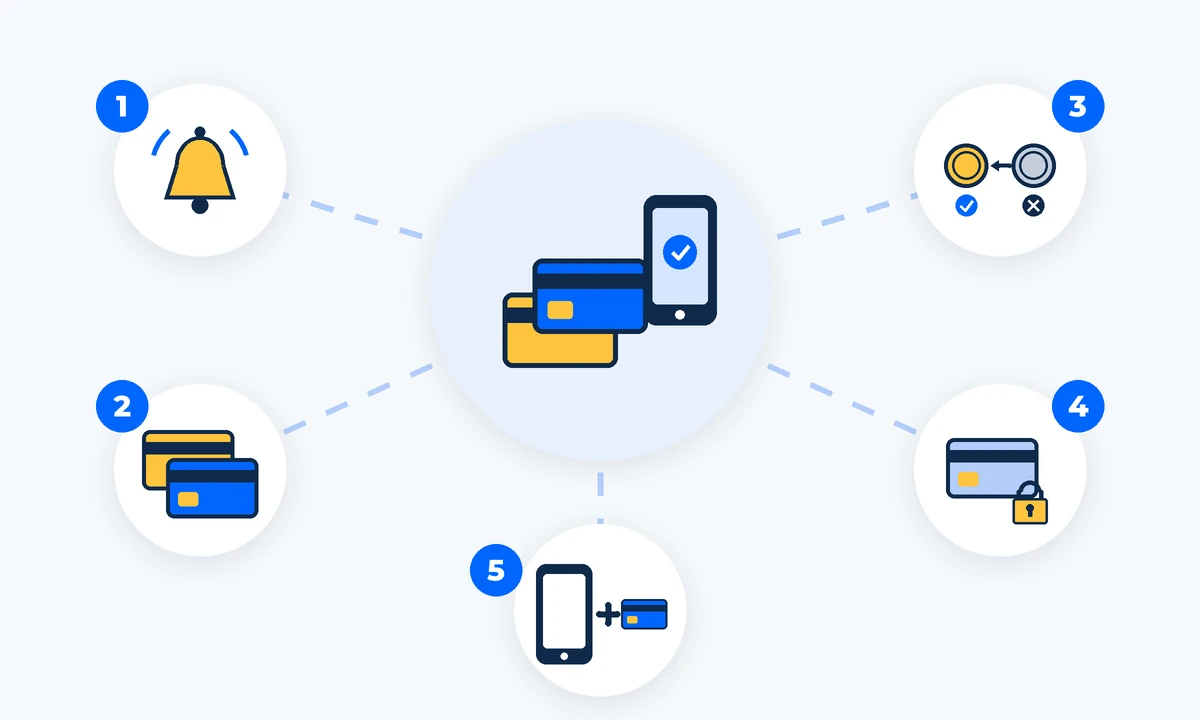
Figure 1. Card and phone payment tips. ① Tell your bank before you travel. ② Bring two cards from different networks. ③ Pay in KRW and check foreign fees. ④ Some sites accept only Korean-issued cards. ⑤ Do not rely on a phone wallet alone.
The Korea Tourism Organization (VISITKOREA) says most businesses in Korea accept credit cards (accessed October 2026). This includes hotels, department stores and general shops. Visa, Mastercard and American Express are widely used. Some places do not take cards, so check before you order.
Korea has many mobile wallets (apps that pay with your phone). Some international wallets work at some Korean shops. But acceptance varies a lot, especially for wallets linked to non-Korean cards. Do not rely on a phone wallet alone. Carry a physical card too.
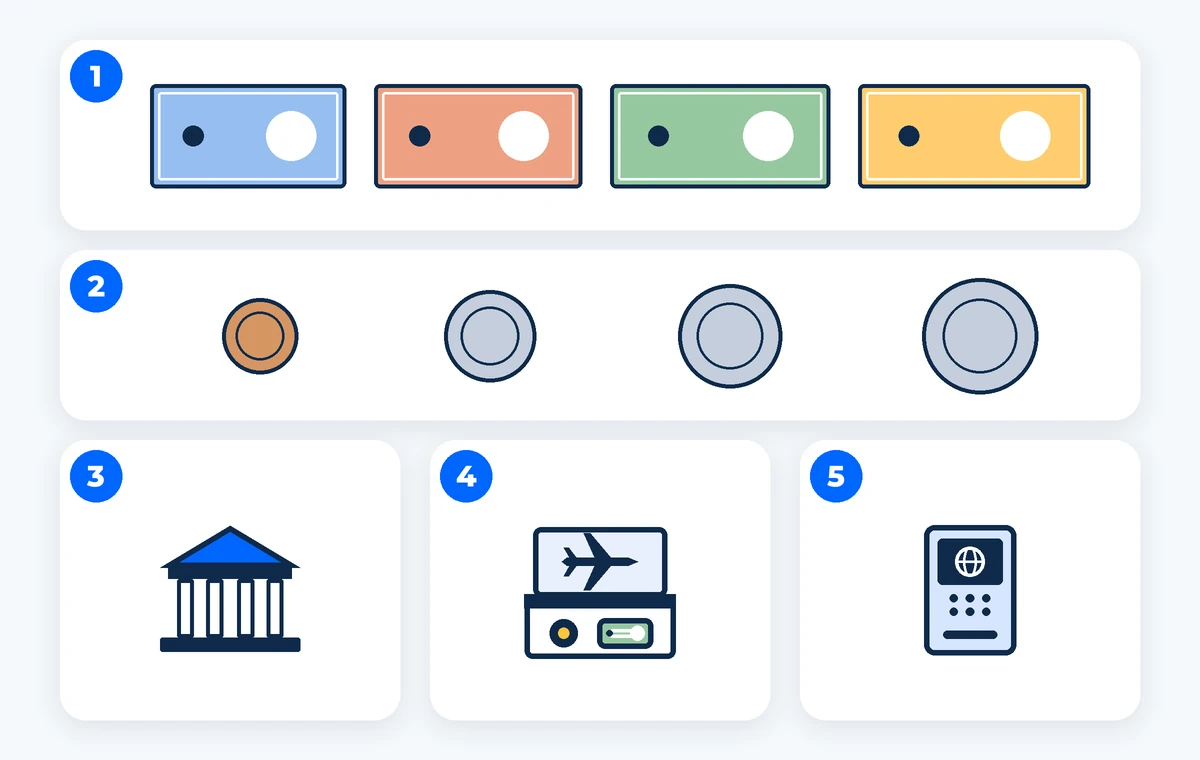
Figure 2. Korean money and where to get it. ① Banknotes: 1,000 / 5,000 / 10,000 / 50,000 won. ② Coins: 10 / 50 / 100 / 500 won. ③ Bank or authorized exchange office (weekdays 9:00–16:00). ④ Airport counter for a small first amount. ⑤ Global ATMs.
Korea’s currency is the won (₩, KRW). According to VISITKOREA (accessed October 2026):
| Type | Values |
|---|---|
| Banknotes | 1,000, 5,000, 10,000 and 50,000 won |
| Coins | 10, 50, 100 and 500 won |
| Place | Good for | Notes |
|---|---|---|
| Bank | Larger amounts | Generally open 9:00–16:00 on weekdays. Hours vary by bank and region (VISITKOREA, accessed October 2026). |
| Authorized exchange office | Larger amounts | VISITKOREA advises using a bank or an authorized exchange service. |
| Airport exchange counter | A small first amount | Open long hours. Convenient on arrival. |
| Global ATM | Withdrawing cash with your own card | See below. |
Many visitors exchange a small amount at the airport and the rest later.
ATMs that accept international cards are common. They are marked with a “Global” sign or the logos of the card networks they accept. Many offer English, Chinese and Japanese. You find them at banks and convenience stores, but convenience store ATMs often charge higher fees (Visit Seoul, accessed October 2026). Your own bank may charge a fee too. So it is often better to withdraw a larger amount fewer times.
VISITKOREA lists a foreigner-only, all-in-one prepaid card called WOWPASS. It combines currency exchange, card payment and transit. The card costs KRW 5,000. You can load it with Korean won or foreign cash (such as US dollars, Japanese yen and Chinese yuan) at WOWPASS kiosks. VISITKOREA says there are 430+ kiosks at major airports, subway stations and hotels (VISITKOREA, accessed October 2026). You need your passport. Compare its exchange rate and fees with your own bank card before you load a large amount.
A modest amount for small shops, markets and transit top-ups is usually enough. Avoid carrying large sums. For a large medical bill, a card or a bank transfer to the institution is safer. It also leaves a record.
Bringing a lot of cash? If you bring more than USD 10,000 in total into Korea (all currencies, Korean won and cheques together), you must declare it to customs on arrival. Not declaring it can lead to a fine or prison (Korea Customs Service, accessed October 2026). Your home country may have its own rules for taking cash out, so check them too.
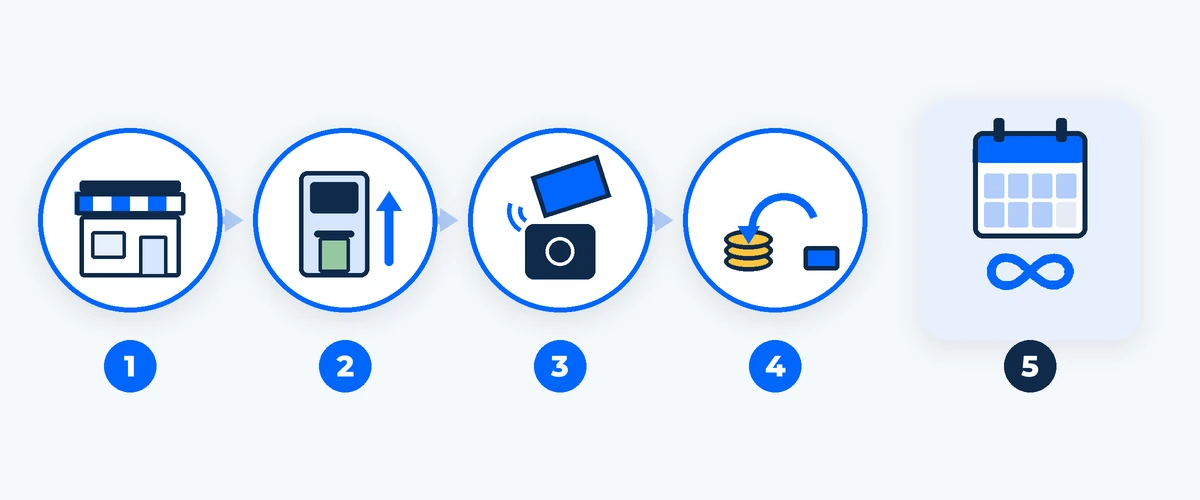
Figure 3. How to use a transit card. ① Buy one at a convenience store, station or the airport (around ₩3,000). ② Top it up, usually with cash. ③ Tap it on the subway, buses and many taxis. ④ Refund the remaining balance before you leave. ⑤ Climate Card: unlimited rides in Seoul for 1–7 days.
T-money is the main transit card. Here is how to use it, step by step, based on Tmoney (25 August 2026) and VISITKOREA (accessed October 2026).
The Climate Card is an unlimited-ride pass for buses and subways in Seoul. Prices for the tourist pass, according to Tmoney (as of August 2026):
| Pass length | Price |
|---|---|
| 1 day | ₩5,000 |
| 2 days | ₩8,000 |
| 3 days | ₩10,000 |
| 5 days | ₩15,000 |
| 7 days | ₩20,000 |
The physical card costs ₩3,000 on top of the pass price (VISITKOREA, accessed October 2026). The pass covers Seoul buses and subways only.
Two official sources talk about different products. A Mastercard press release (9 April 2026) says visitors can use the MobileTmoney app on iPhone or Apple Watch and top it up with a Mastercard card in Apple Wallet. Tmoney’s visitor guide says iPhones cannot issue a mobile card, but that note is about the Climate Card Tourist Pass only, not all mobile T-money services (Mastercard and Tmoney, checked Oct 2026). Check that your phone, the app and your payment card are supported for the product you choose. A physical card is a simple backup. Android users should check the official app store listing before relying on a phone.
After some procedures, you may prefer taxis to crowded subways. See our guide on getting from Incheon Airport to Gangnam.
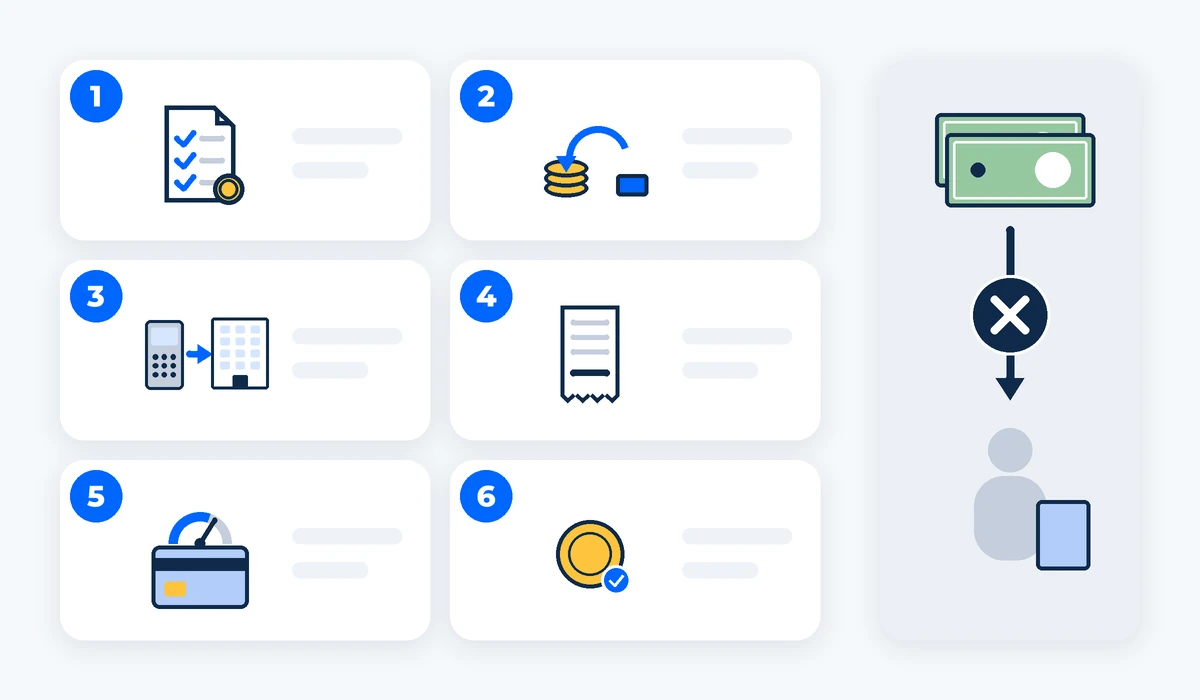
Figure 4. Checklist for paying medical bills. ① Get a written quote. ② Ask about deposits and refunds. ③ Pay the institution directly, never to a personal account. ④ Keep receipts and the itemized bill. ⑤ Check your card limit. ⑥ Pay in KRW.
Medical payments are larger than everyday spending. Plan ahead with these steps.
VAT (value-added tax) is a tax included in the price of goods and services. Korea had a special VAT refund for foreign tourists’ cosmetic procedures. It started in 2016. It was not extended in the 2025 tax reform and ended on 31 December 2025 (Korea.kr, 2025 tax reform). Proposals to bring it back have not been passed (as of October 2026). So procedures from 1 January 2026 are not eligible under that scheme.
Normal tax-free shopping refunds for goods are a separate system. See also our guide on VAT refunds for foreign patients.
Can I use my foreign credit card in Korea? Yes, in most places. VISITKOREA says most businesses accept credit cards, and Visa, Mastercard and American Express are widely used (accessed October 2026). Some small shops and some Korean websites do not.
Where is the best place to exchange money? VISITKOREA advises a bank or an authorized exchange service. Banks are generally open 9:00–16:00 on weekdays. Exchange only a small amount at the airport.
How much does a T-money card cost? Around ₩3,000 for a basic card, with the balance loaded separately (Tmoney, as of August 2026).
Can I top up a transit card with a foreign card? Usually not. T-money top-ups at stores and most machines are paid in cash (T-money, accessed October 2026). From March 2026, the Seoul Climate Card can be bought and topped up with an overseas card at new machines on Lines 1–8, with a fee of about 3.7% (Tmoney, as of August 2026).
Can I still get a VAT refund on cosmetic procedures? No. The scheme ended on 31 December 2025, and proposals to revive it have not been passed (as of October 2026).
Do I need to declare cash when I arrive? Yes, if you bring more than USD 10,000 in total, in any currencies (Korea Customs Service, accessed October 2026).
How should I pay a large medical bill? Pay the institution directly by card or to its business account. Never pay cash to a personal account. Keep the receipt and itemized bill.
If you’d like help planning, you can talk to a coordinator.